Week 4 was about narration, aesthetics, screen grammar.
Within narration we went over the three act structure (beginning, middle and end). This is for a set up, conflict and resolution. This is how almost every story is structured to keep the end user entertained. However not all stories need to follow it in this order. Some stories will be in non-chronological order. In this session we watched the short documentary called blue, about the colour blue. This did not follow a normal chronological order.
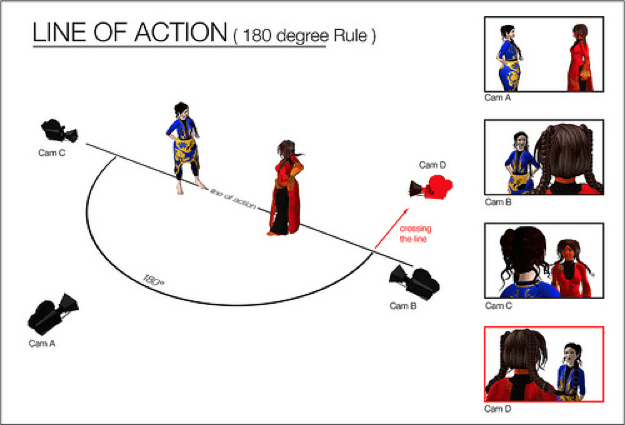
We also talked about the 180 degree rule. This is to make conversations look cohesive. In the diagram we can see how the 180 degree rule works. The camera can not be placed outside of the semi circle shown. This is because the characters will appear to have moved within the shot. In Cam A, B and C we can see that the blue character is always on the left and the red on the right. As soon as the camera goes outside of that 180 degrees this switches.
Another technique we went over was the rule of thirds. This is an aesthetic technique to make shots look more appealing. This means that the focal point of the shot should be in one third of the screen as seen in the photo below. We can see that the man in aligned with the right most third and his eyes with the top third. This rule also states that when you cut to another shot it must be in a third directly next to previous shot. For example this shot could either cut to the lower right third or upper left but not the bottom left. This is due to the eyes having to move further and it being an unnatural movement.

This rule can sometimes be broken however. If you want the watcher to feel some kind of tension or to not like the next person or thing in shot, this helps with that. You can also use the way people face to achieve the same thing. If everyone from one group is facing the left and you want an opposing group to be seen as different you can make them face another direction, causing the watcher to move their eyes.
Another things to consider is camera placement. When interviewing someone the camera should ideally be placed at eye level forming a mid shot. This makes it feel like you are directly talking to the person who is being interviewed as this is generally what you see when you talk to someone.
When interviewing someone it is also important to consider what is in the background, and how this can help signify what the person is or what they are doing. Establishing shots and cut aways also help with establishing where someone is or what they are doing.
 Hazel's Documentary Blog