Week 11

This week I spent my time making the documentary as well as finishing off all the documents and files needed. This is how my finished documentary timeline window looked.
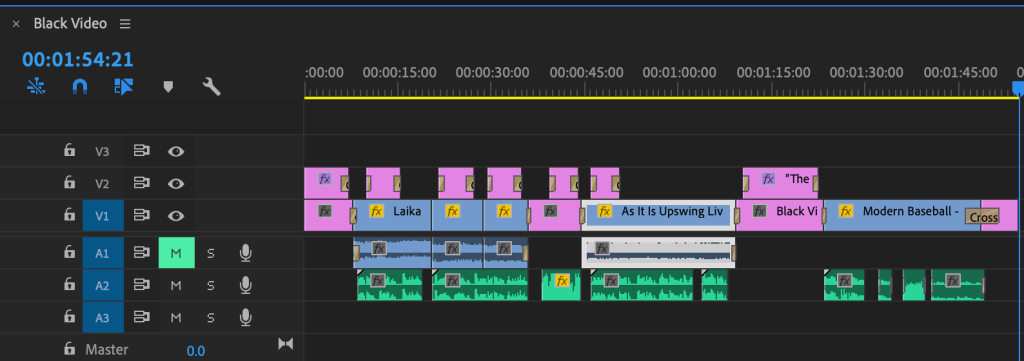
I was struggling with the computer I had to edit the footage I had. The more things I added to the timeline the slower everything became and the playback kept dropping frames. This made it more and more difficult to edit as the project got longer and longer. In the bottom right hand side of the playback window I saw that I was able to edit the playback quality, I set this to the lowest I could which was 1/4. Another way I got around some slowdown was by adding the transitions and text as the end of the project, I assumed this made it easier for the computer to deal with workload as there was not as much going on on the screen at once.
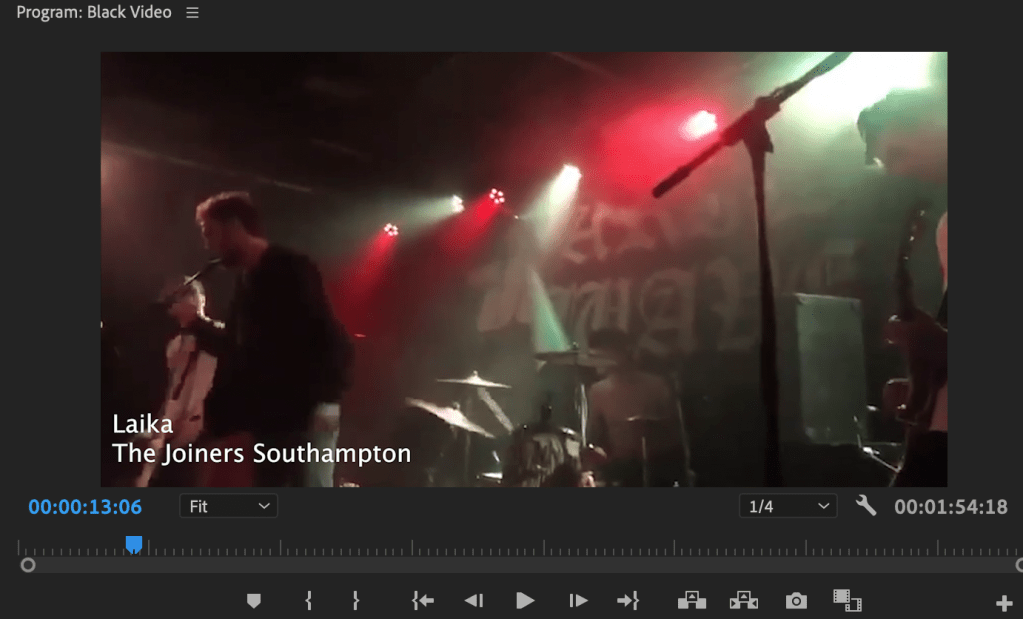
The Combination of only being able to use archival footage and having issues with the editing and playback of the project made this very frustrating to deal with. However I did what I could with the resources I had available to me at this time.

To record audio I used audacity and my built in webcam microphone. I was planning to use some of the microphones I use for my music work however I do not have these with me at this time so I had to use what I had available to me at the time.

Overall I wish I could have gone with the original project however I understand that it would not be possible in the current situation. That project would have had a lot more substance and being at university I would have been able to edit on a computer that was more capable.
Week 10

Week 10 was spent gathering sources for this new project. This was tricky as due to the time I had left. Most of the sources for background were of videos I pulled from youtube, this was because I could not obtain footage of the venue any other way. I also asked around to see if anyone had any videos taken when the venue was open, this unfortunately did not lead to any clips. I had some interviews for another project with URF radio about the Brighton music scene so was able to use that for the section about the local Brighton sound.

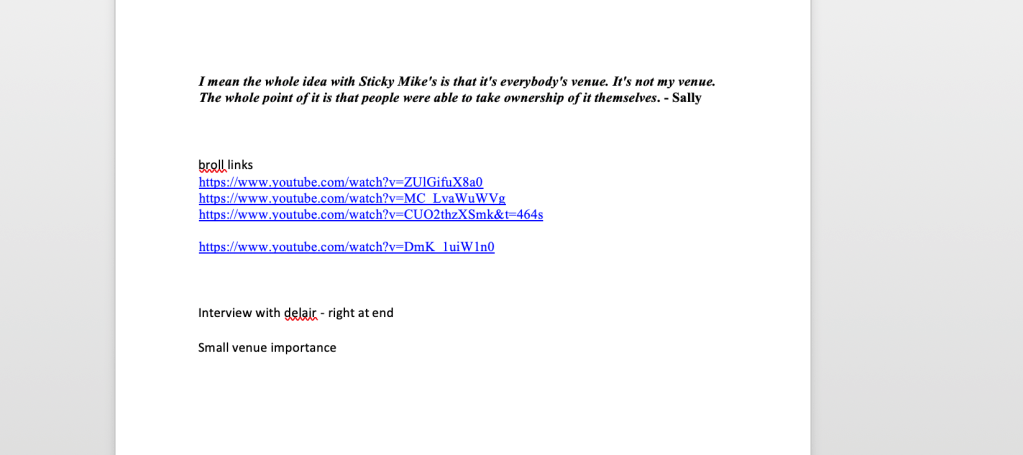
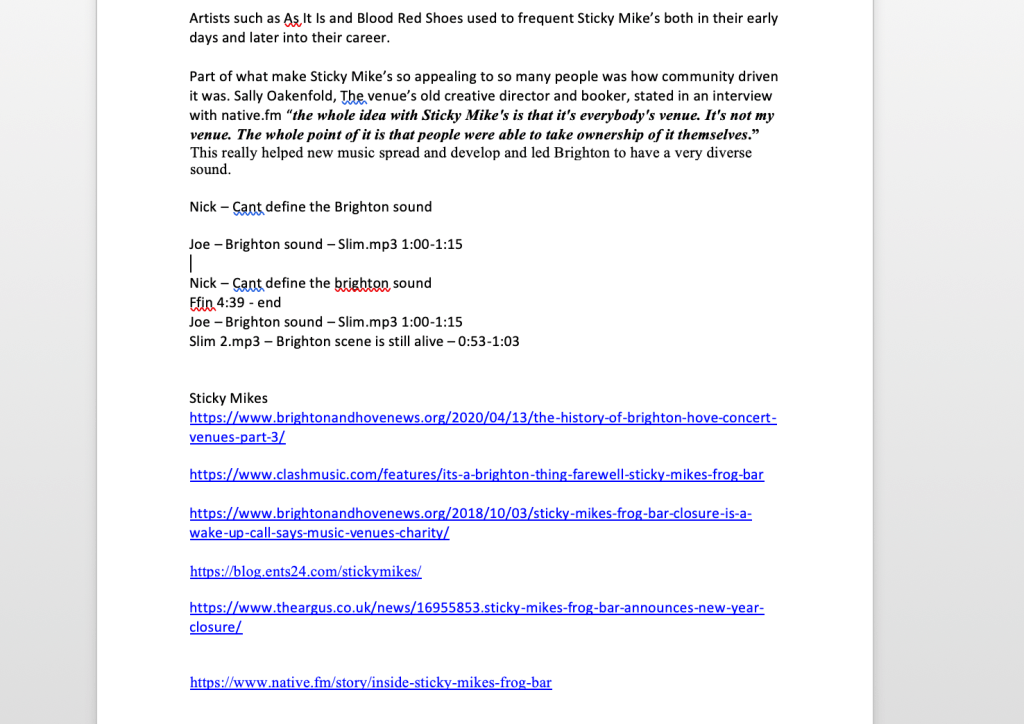
When compiling these sources I put them all into a word document with timestamps with useful bits of information. This was also accompanied by a rough script I would be following for the voice over and sourced I used.

This helped me keep track of all of the information I had gathered and decide what was useful and what was not.

Once this was done I started to write the dual column script. This was a more concise version of what was in my document above with a final version of the voice over script.

Week 9

This week was very tricky for me. I was moving back home from Brighton and still had no video filmed. The Hope and Ruin the week before had told us we could not realistically film our project. I had also decided to go home before a lockdown was called across the country. During this time my group had also decided it was easier to do our own projects. This meant that i would need to start most of this project from the start.

At first I wanted to keep to the same project idea however later I decided to change the project slightly. I decided on doing it on Sticky Mike’s Frog Bar. This is because the venue is now closed, that means if the end product would not be far different even if I could actually film in Brighton.

Week 8

Week 8 was about editing and how to edit our films. The job of editing is basically to take all of the footage we have taken and streamline it into an end product that someone might want to watch. This includes taking out mistakes, bits that might confuse the audience or any other unneeded sections of video. Editing also allows us to put in voice overs as well as any still photos we captured.

Week 7

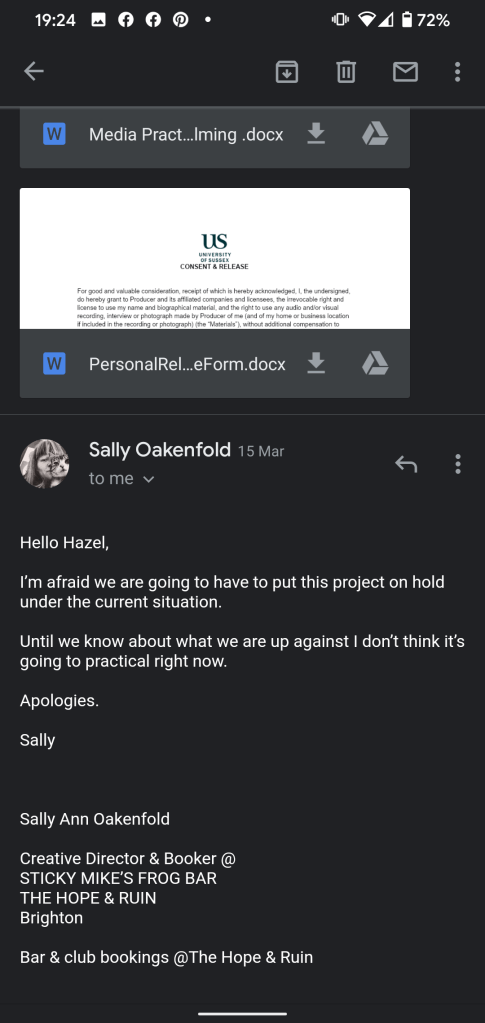
We started to encounter problems in week 7 due to COVID-19 getting more and more prevalent in the Brighton area. We used this time to go and see Sally about progression of the project. During the meeting we went over which events we would like to attend to film. We decided on one gig and one craft event. This was to show the range of the events that The Hope and Ruin. We also used this time to talk about the consent and release forms as well as some questions we would like to ask. This was just so there was complete transparency with the project we were doing. Sally also mentioned about how the venue might not be open the following week due to COVID-19. Later that week we received the email below stating that now would not be the best time to do this project.

After we received this email we had to a rethink project idea. This also included all of our other work such as story board.

Week 6

Week 6 was about editing within premier pro and how the program works as well as general workflow improvements.

One of the important things that we went over in the PDF attached was backing up data. Our media drive will backup all of our data everyday however you do not want to be working off of the media drive. This means when you take the videos and audio you will need to back it up onto the media drive right away, this means the data is always backed up. It is also recommended to have any safe data on 3 drives. One on the computer its self, one on an external hard drive or usb stick and another kept in a separate location. This is in case the location you are at has a flood/fire. My photos and notes are all backed up onto Google Drive/Photos as I create them. As for videos I will be taking during the project I will back these up to my computer, hard drive and university media drive. I do not want to use Google Drive for this as they files will be very large and I would need to pay for more space.

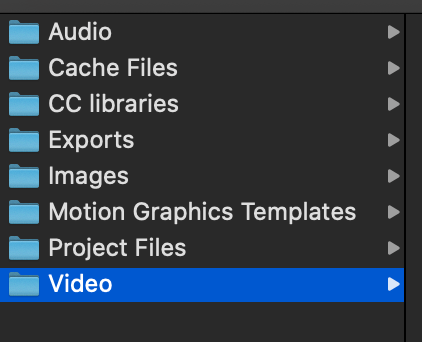
It is important to sort all files into the correct folders so they can be found easily. This is how I sorted my file structure.

Week 5

Week 5 is when we did our group presentations. This covered our idea, any technical bits of information, aesthetic choices, narrative elements, the ethics of the documentary and production roles. We also linked this back to another documentary which was FYRE: The Greatest Party That Never Happened (2019). This covered the failure of FYRE festival how and why it failed.

In this week we also finalised the direction of the documentary. We decided we were going to focus on the closure of pubs and music venues and how The Hope and Ruin were doing so well.

We also went to The Hope and Ruin for a few meetings with Sally. This also helped us look at the location for possible b roll situations. It also helped us understand what kind of equipment we would need to bring. As the pub was fairly dark we would either need to bring some lights or control the exposure on the camera. We decided that a tripod would not be that useful as most of the pub was fairly cramped and we wanted to be as in the way as little as possible.

Visiting the pub also allowed us to story board a little better as we had some idea about where to film specific bits of our story.

Week 4 Cont

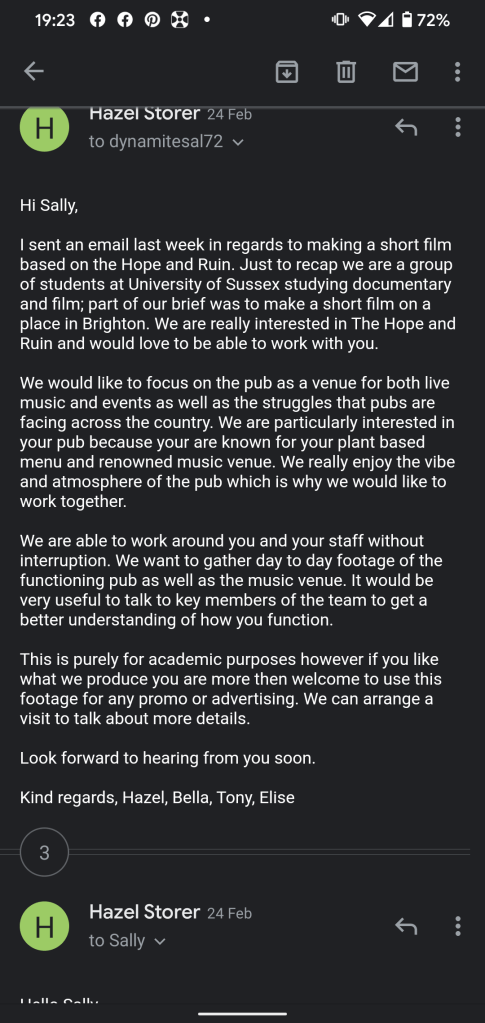
This is also the week where we established our final project. I managed to get a contact email from a friend who worked at The Hope and Ruin. This was and email for Sally who is the creative director and booker. We organised a meeting with Sally after I sent the email seen below.

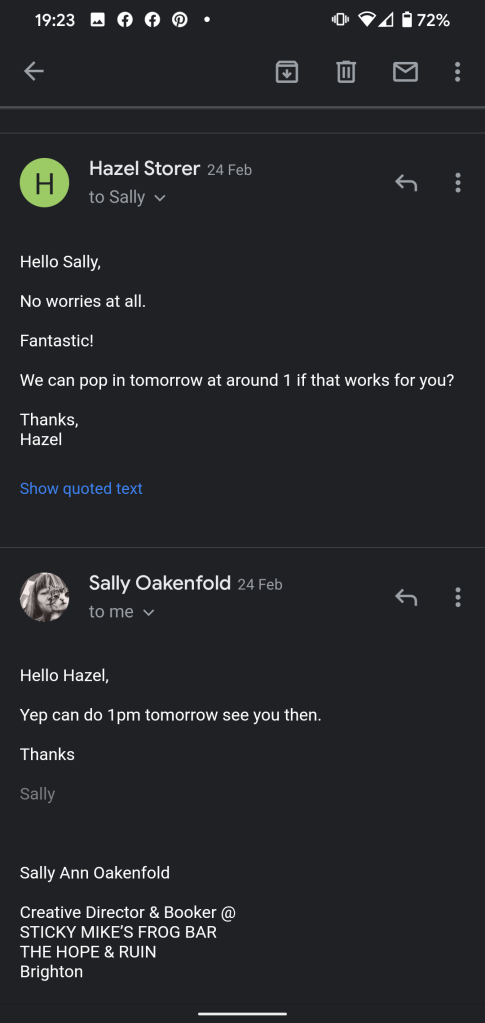
We received a reply fairly quickly after this. Which is seen below.

Week 4

Week 4 was about narration, aesthetics, screen grammar.

Within narration we went over the three act structure (beginning, middle and end). This is for a set up, conflict and resolution. This is how almost every story is structured to keep the end user entertained. However not all stories need to follow it in this order. Some stories will be in non-chronological order. In this session we watched the short documentary called blue, about the colour blue. This did not follow a normal chronological order.

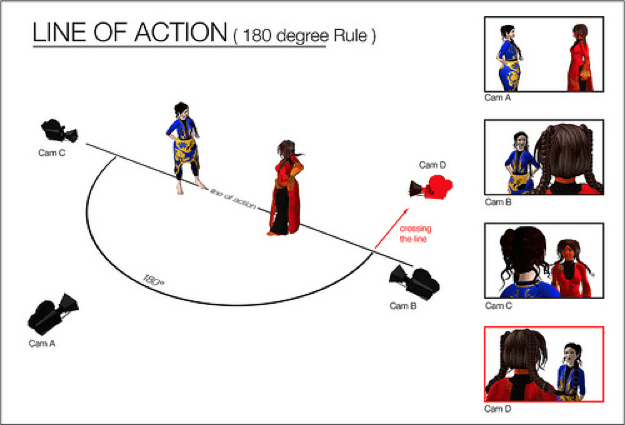
We also talked about the 180 degree rule. This is to make conversations look cohesive. In the diagram we can see how the 180 degree rule works. The camera can not be placed outside of the semi circle shown. This is because the characters will appear to have moved within the shot. In Cam A, B and C we can see that the blue character is always on the left and the red on the right. As soon as the camera goes outside of that 180 degrees this switches.

Another technique we went over was the rule of thirds. This is an aesthetic technique to make shots look more appealing. This means that the focal point of the shot should be in one third of the screen as seen in the photo below. We can see that the man in aligned with the right most third and his eyes with the top third. This rule also states that when you cut to another shot it must be in a third directly next to previous shot. For example this shot could either cut to the lower right third or upper left but not the bottom left. This is due to the eyes having to move further and it being an unnatural movement.

This rule can sometimes be broken however. If you want the watcher to feel some kind of tension or to not like the next person or thing in shot, this helps with that. You can also use the way people face to achieve the same thing. If everyone from one group is facing the left and you want an opposing group to be seen as different you can make them face another direction, causing the watcher to move their eyes.

Another things to consider is camera placement. When interviewing someone the camera should ideally be placed at eye level forming a mid shot. This makes it feel like you are directly talking to the person who is being interviewed as this is generally what you see when you talk to someone.

When interviewing someone it is also important to consider what is in the background, and how this can help signify what the person is or what they are doing. Establishing shots and cut aways also help with establishing where someone is or what they are doing.

Week 3

For Week 3 we had to prepare our documentary pitch idea. Our group had a few ideas. We finally decided on two. One about a busker under the bridge just off campus. The other was about the fast food chain Grubbs; which is specific to Brighton. I had thought this might have been a good idea as I had overheard a conversation in one of their restaurants about their history. After looking into their company and food options a little more we decided to move away from this and do our project on The Hope and Ruin, a music venue and vegan pub in Brighton. We felt this place gave us a little more to talk about and film as we could focus on the live music aspects as well as their food and bar.

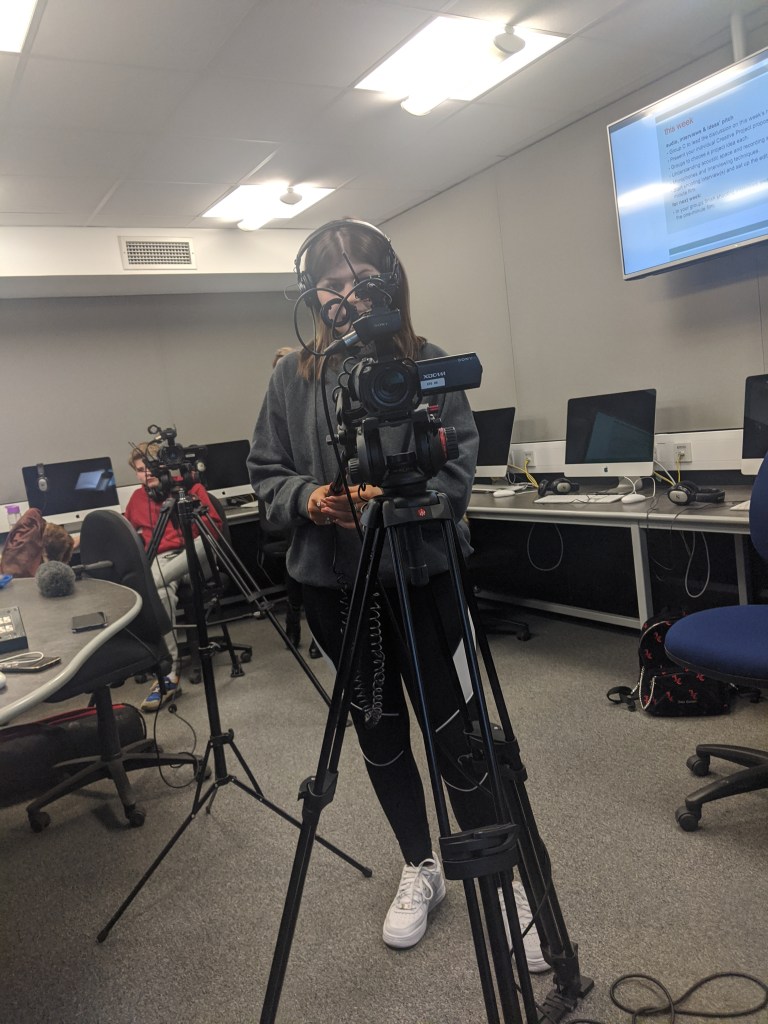
During this session we also recorded the pitches so we could get used to the camera and microphones we were using. The camera was the same Sony X70 and the microphones were a clip on lavalier microphone and a boom microphone. The lav mic was secured to the interviewee and boom mic was placed on top of the camera. It was important with both microphones the the gain was set correctly, this was to stop clipping or any distortion when talking. It was also important where we were filming as background sounds could possibly be heard. We recorded in the room the session was taking place in, this was not ideal as you could hear the air conditioning in the background of the audio. However as this was only a practice run we did not worry too much.

Another thing to consider whilst recording audio was which microphone to use when. The lav mic needed to be clipped onto a person, this meant it would pickup more of the person than the ambience of the room. This would be ideal for recording one or two people having a conversation as long as you had one microphone for each person. The boom mic was much more useful for general room ambience and room sounds.

Design a site like this with WordPress.com
Get started